IQ Option Trading Basics: Spreads, Swaps, Margin, Leverage
Writen By

Online Trading Platform Researcher and Guide Writer
Researches broker platforms and trading account Systems.
Traders often focus on entry points and indicators while overlooking cost and capital mechanics that shape trade outcomes. Spreads, overnight swaps, margin requirements, leverage and currency conversions all change the effective cost, required capital and risk profile of a position. On IQ Option these components can differ by asset and session, so learning how they’re calculated helps you size positions correctly, forecast overnight charges and factor costs into risk–reward analysis before placing any live trade.
This overview shows where to check spreads and swap rates in the platform, how leverage alters margin needs and liquidation thresholds, and how currency conversion fees apply when your account and asset currencies don’t match. Use the demo account to compare quoted spreads and practice setting leverage; on live accounts always review instrument specifications, monitor margin level alerts and limit position size so costs don’t erode capital during volatile moves.
This overview shows where to check spreads and swap rates in the platform, how leverage alters margin needs and liquidation thresholds, and how currency conversion fees apply when your account and asset currencies don’t match. Use the demo account to compare quoted spreads and practice setting leverage; on live accounts always review instrument specifications, monitor margin level alerts and limit position size so costs don’t erode capital during volatile moves.
Spreads
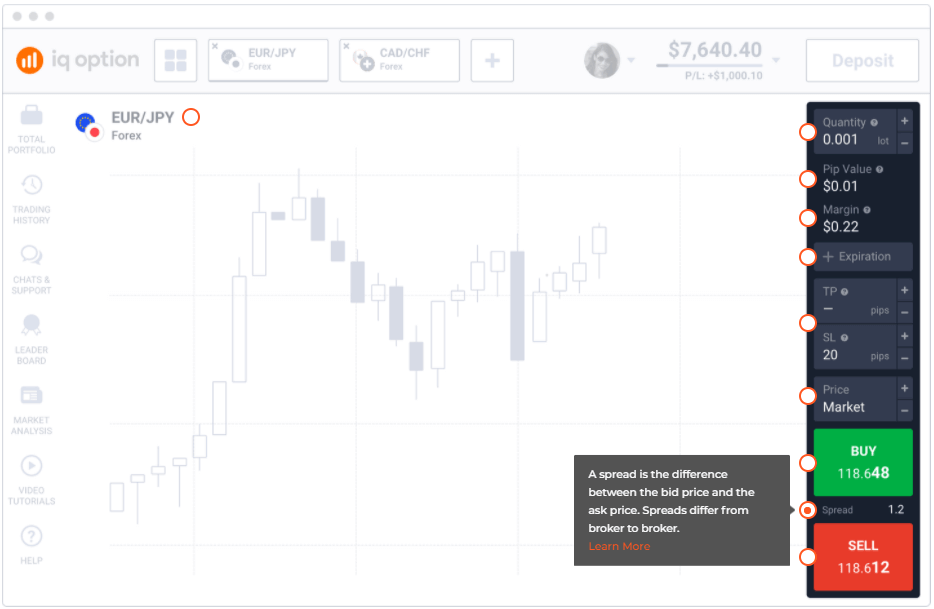
A spread is the difference between the bid price and the ask price. Spreads differ from broker to broker.
To calculate the cost of a spread on the IQ Option platform, use the following formula:
Cost of a spread = Lot size × Contract size × Spread
Example
EUR/USD Ask: 1.13462 Bid: 1.13455
Spread: 1.13462 – 1.13455 = 0.00007
Trade size: 2 lots
Contract size: 100.000 units of the base currency (=200,000 EUR)
EUR/USD cost of spread = (1.13462 – 1.13455) × 2 × 100.000 = 14 USD
Swaps
A swap is an interest charge that a trader has to pay to a broker for holding positions overnight.Swaps arise from the difference in interest rates of currencies plus the broker’s administrative fee. In forex trading, you borrow one currency in order to buy another. A swap depends on whether you buy a currency with a higher or lower interest rate compared to that of the currency you borrow. Swaps can be positive and negative.
If you buy a currency with a higher interest rate than that of the borrowed one, you will receive a positive swap. Let’s look at the following example.
Example
The American interest rate is 1.75%.
Australia’s interest rate is 0.75%.
The administrative fee is 0.25%.
If you open a long position on the USD/AUD pair, a swap of 0.75% will be credited to your account, as the currency you buy (USD) has a higher interest rate than the currency you borrow (AUD).
If you open a short position on the same currency pair, a swap of 1.25% will be debited from your account, because the currency you borrow (USD) has a higher interest rate than the currency you buy (AUD).
Margin
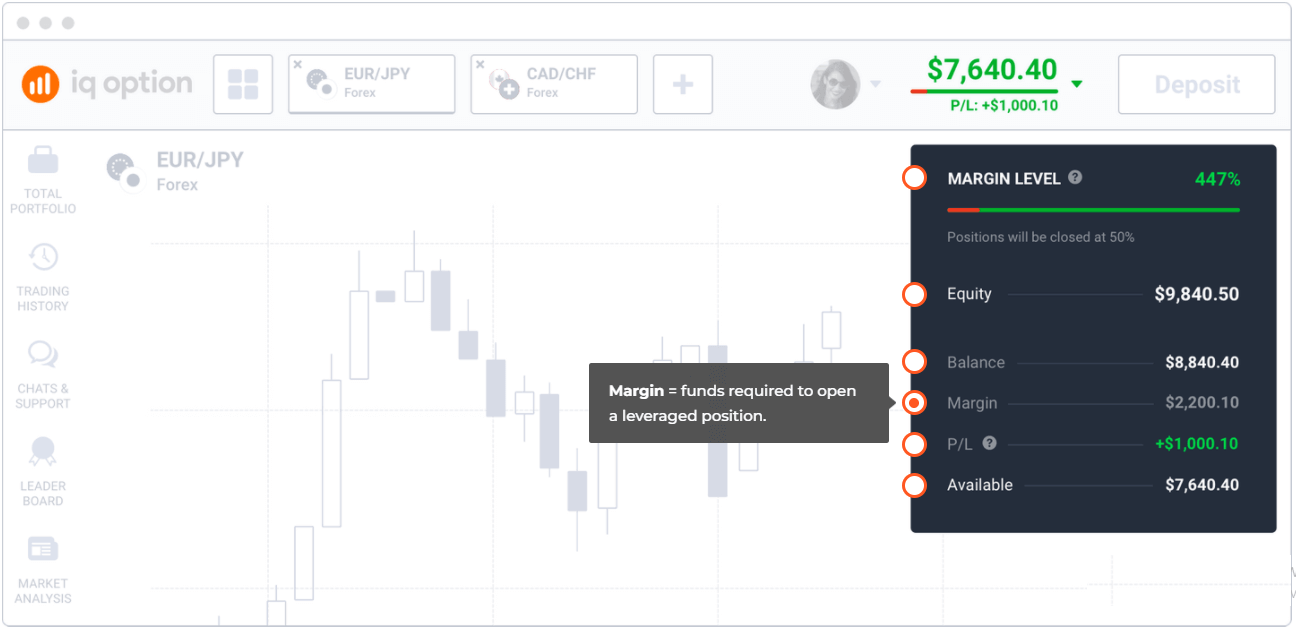
Margin is the amount of a trader’s funds required to open a leveraged position. Margin allows you to trade with leverage, which is essentially using borrowed funds from a broker in order to increase the size of your trades.To calculate a margin on the IQ Option platform, use the following formula:
Margin = Lot size × Contract size / Leverage
Example
You intend to buy 0.001 lots (1,000 units) of the EUR/USD currency pair with a 1:500 leverage. The margin required to open this trading position is 0.2 EUR. Check out the detailed calculations below:
Currency pair: EUR/USD
Lot size: 0.001 lot
Leverage: 1:500
Contract size: 100,000 units of the base currency
Margin = 0.001 × 100,000 / 500 = 0.2 EUR
Please note that conversion may apply if your account currency differs from the base currency.
Leverage
Leverage allows you to trade positions larger than the amount of capital you possess. Leverage maximizes payouts, but it also maximizes losses.Example
Let’s assume you have deposited $1,000 into your account and are using a 1:500 leverage. In this case, your buying power will increase by 500 times, to $500,000, which means you can place a trade with a value of $500,000.
Please note that leverage varies for different assets.
Conversions
Currency conversion rates may apply in some cases. This occurs due to the fact that each parameter of a trade is denominated either in the base currency or quote currency. A contract size and margin are denominated in the base currency, while payout is always calculated in the quote currency. Hence currency conversion rates may apply for calculating margin and payouts. If your account currency differs from the quote currency, conversions will apply. Let’s look at the following examples to understand when currency conversion may be required.Example 1: Base currency = account currency
Let’s assume that your account currency is USD and you are trading the USD/JPY currency pair. Conversion will not apply when calculating the margin, as the base currency (USD) is the same as the account currency (USD). Conversion will apply when calculating the payout: first, it will be calculated in JPY, the quote currency, and then converted into USD, the account currency.
Example 2: Quote currency = account currency
Let’s assume that your account currency is USD and you are trading the EUR/USD currency pair. Conversion will apply when calculating the margin, as the base currency (EUR) differs from the account currency (USD). Conversion won’t apply when calculating payouts, because the quote currency (USD) is the same as the account currency (USD).
Example 3: No matches
Let’s assume that your account currency is GBP and you are trading the AUD/CHF currency pair. Conversion will apply when calculating the margin, because the account currency (GBP) differs from the base currency (AUD). Conversion will also apply when calculating payouts: first, it will be calculated in CHF, the quote currency, and then converted into GBP, the account currency.
Margin level
Margin level helps you monitor your account health: it shows whether everything is going well or not and suggests when you should close positions that are not profitable.To calculate your margin level, use the following formula:
Everything is indicated in the account currency:Margin level = Equity / Margin × 100%
Margin call and Stop out
Margin call
When a trader’s margin level falls below 100%, the broker initiates a procedure known as a margin call. In the event of a margin call, the trader is required to either deposit more money into his/her account or close losing positions. If the margin level falls below 50%, losing positions will be forcibly closed by the company.Maintenance margin
Maintenance margin is the minimum amount of capital a trader must have in his or her account in order to keep a leveraged position open.Stop out
A stop out is an event that occurs when a trader’s equity is not sufficient to maintain open positions, hence they get forcibly closed by the broker. FAQs
Spread is the difference between buy and sell quotes and represents the immediate cost to open a position; IQ Option lists spreads per instrument in the asset details. Spreads are typically variable, measured in pips or points, and widen during low liquidity or high volatility so check the live quote before execution.
Swap is a financing charge for holding positions past the platform’s rollover time and depends on the asset, the direction of your trade and interbank interest differentials. IQ Option calculates swap per unit or lot using its rate schedule; fees appear in the position details and are applied at rollover—review the instrument’s swap rate and use the demo to compare expected overnight costs.
Minimum margin depends on the instrument’s notional size and chosen leverage: required margin = notional value divided by leverage. IQ Option shows required margin in the trade ticket or instrument specs; use a smaller lot size or lower leverage to reduce margin needs and avoid unexpected blocks on order placement.
Higher leverage lowers the capital needed to open a position but magnifies losses and reduces your margin buffer. If market moves reduce your equity below maintenance thresholds, margin calls or automatic position closures can occur. To manage risk monitor equity versus used margin, set conservative stop-losses, lower leverage or reduce position size and keep a liquidity buffer to withstand volatility.
Open the specific instrument’s details or the trade ticket to view current spread, swap/overnight rate and the leverage options; the platform shows required margin when you enter position size. For currency conversion, check your account currency settings and the conversion rate that applies at deposit or trade execution, and confirm figures in the demo before trading with real funds.